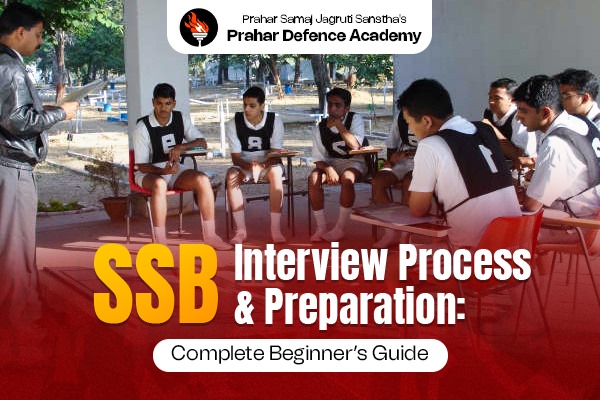
SSB Interview Process & Preparation: Complete Beginner’s Guide
The NDA exam is one of the most applied-for exams in India which attracts students from all across India interested to serve in the Indian military forces. Among the various phases of the exam, a major phase where a majority of students do not get recommended in the Services Selection Board (SSB) Interview. The 5-day-long SSB interview process is conducted to test your personality, thinking patterns, leadership potential, and emotional stability through a series of different tests where a massive number of students do not make it. To crack this interview process, they need proper guidance and preparation.
What is SSB Interview?
The first question you need an answer to after knowing the complete process of NDA examination is what is SSB (Service Selection Board) interview. As for your answer, the process of SSB Interview tests the candidates interested in becoming an officer in the Indian Army, Navy, and Air Force several Officer-Like Qualities (OLQs) i.e,are expected to be displayed. These qualities include teamwork, emotional maturity, decision-making, leadership, communication skills, risk taking ability and many more.
The interview includes a series of carefully planned psychological tests, group activities, and personal interviews for all candidates.
The SSB interview is conducted to test the natural personality, knowledge and abilities of a candidate.
Every candidate is assessed by a psychologist, GTO (Group Testing Officer), and interviewing officer.
The testing process remains same for the Army (SSB), Air Force (AFSB), and Navy (NSB).
How is an SSB Interview Conducted?
The SSB interview tends to be longer than the earlier conducted tests and takes place over five consecutive days. Candidates are required to appear for a different test every day. For the tests to not come as a surprise, candidates are supposed to prepare very dedicatedly in advance. Before the Day 1 starts, the candidates have to arrive and report at their assigned centre a day prior.
Day 1: Screening Test
On Day 1 of the interview, i.e., during the screening test, students are tested for their quick thinking, clarity of expression, and situational interpretation abilities. Two tests are conducted on this day:
OIR (Officer Intelligence Rating Test): It consists of 50 questions in its two sets of verbal and non-verbal reasoning tests, conducted for 30 minutes each, evaluating the analytical ability and mental sharpness of the candidate.
PP&DT (Picture Perception and Description Test): During PP, candidates get to view a blurry picture for 30 seconds, write its details in 1 minute, and form a story around it in 4 minutes. In DT, a group of candidates are made to tell their story in 1 minute, after which all of them have to make a group story including elements from the story of each candidate.
Result of these 2 tests, decide the number of cadets who would stay for the rest of the 5 days for further assessment.
Day 2: Psychological Tests
On Day 2, four psychological tests are conducted to evaluate your personality and emotions.
Tests conducted:
TAT (Thematic Apperception Test): You have to write stories for 11 blurry images shown to you along with 1 blank slide.
WAT (Word Association Test): You are shown 60 words for 15 seconds each, and you have to build 60 meaningful sentences based on each word.
SRT (Situation Reaction Test): You get a booklet with 60 different situations, and you have to write your response to them in 30 minutes.
SD (Self-Description Test): You have to write about your strengths, weaknesses, your opinion about yourself, and what opinion your parents, teachers, friends, etc., have of you.
Day 3: GTO Tasks (Part 1)
You are tested for your ability to perform in a group to test your teamwork, communication, leadership, confidence, and decision-making in group settings.
Tasks:
Group Discussion (GD) - You have to take part in a group discussion, discuss two topics one after another for 15-20 minutes, put forward your views, and influence your group.
Group Planning Exercise (GPE) - 6-12 candidates are put in each group. Each group is given a problem, and all candidates undergo personal planning. Later, the group has to decide on a common solution through discussion .
Progressive Group Tasks (PGT) - You are made to cross certain hurdles with heavy-weight objects like wooden planks, ropes, etc., in the shortest time possible.
Group Obstacle Race (GOR / Snake Race) - You have to cross an obstacle with the help of a rope tied to the obstacle like a snake.
Day 4: GTO Tasks (Part 2)
The group tasks continue on Day 4 to evaluate personal qualities like initiative, courage, and stamina.
Lecturette - You have to choose one out of four given topics and speak on it for three minutes.
Individual Obstacles – You have to cross ten obstacles back-to-back with some points for you at each obstacle.
Command Task – You have to act as a commander, choose your own team, and command the team to successfully complete a given task.
Final Group Task (FGT) – This is the group activity testing your problem-solving, leadership, and coordination abilities.
Day 5: Interview + Conference
Day 5 is the final day of the test, where you have to appear for a personal interview and a conference in front of all the assessors who can decide your suitability.
Components:
Personal Interview - You are tested by one assessor who asks various questions and analyzes your personality, honesty, clarity of thought, and officer-like qualities.
Conference - You have to appear in front of three assessors who discuss your performance in-depth. The conference round generally takes place for a very short duration.
SSB Interview Preparation Guide
As the majority of the candidates who are a part of the SSB interview process who don't make it, the question that appears in front of them is how to clear SSB interview. As the answer to many such questions, students go on to find better preparation guidance, which are necessary for them. The following are some tips that you need to follow and keep in mind to clear the SSB interview:
1. Improve Communication Skills
In any round or stage, whether it be the GDs, interviews, or GTO tasks, proper communication skills are necessary. A portrayal of communication skills includes expressing your ideas clearly, confidently, and respectfully. Here is how you can improve your communication skills:
Practice speaking English daily for 10–15 minutes.
Watch English news debates.
Record your own voice and listen to it to find imperfections in your communication and speech patterns.
Read English language newspapers regularly.
2. Self-Awareness
Self-awareness is the core of your performance in the psychological test where the assessors want to see your real or natural personality and not a temporarily made-up one. In case you try to show your fake qualities, the assessors are expert enough to catch the lie. The following are some tips on how you can assess yourself:
Be honest with yourself during preparation. Write down your strengths and weaknesses and put on effort to eliminate the weaknesses.
Understand your daily challenges and your natural reactions or efforts made to solve those challenges.
Prepare how to explain your academic and personal background thoroughly.
3. Time Management
Almost all tests, especially the WAT, SRT, and PP&DT, during the different days of the SSB interview require quick thinking and action. You need to build time management skills and hence learn to take decisions with calmness even under pressure. Here is how you can improve your time management:
Solve reasoning questions with a timer to repeatedly monitor and improve your speed.
Practice writing short stories within a very short duration.
Create daily study and fitness routines and follow them consistently.
Break large tasks into smaller ones to avoid last-minute pressure.
4. Physical Fitness
Physical Fitness is synonymous to Defence Forces. Hence, you need to look prepared to be a soldier or a professional army officer of any wing. Proper fitness also helps in boosting your stamina, energy, and discipline - essential qualities to be a military officer.
Jog or walk at least 2–3 km daily.
Practice basic exercises like push-ups, squats, planks, and skipping.
Be active in sports like football or basketball to improve your stamina and agility.
Maintain a healthy diet and keep yourself properly hydrated at all times.
5. Teamwork
One of the major qualities tested during the SSB interview, particularly during the GTO tasks, is teamwork. It shows your ability to collaborate, support others, and work as part of a team in perfect coordination. This is how you can boost your teamworking abilities:
Participate in group activities at school, college, or your workplace.
Be a good listener, never interrupt others during a discussion, and respect the opinions of every person.
Give your ideas to any situation of need and be ready to accept constructive criticism.
Understand the strengths and weaknesses of all your group members.
Conclusion
Along with the knowledge of a person, the 5-day-long SSB interview is an evaluation of one’s personality and skills that would be needed on different days of their dream as a military officer. When you learn how to prepare for SSB interview with discipline and genuine efforts towards self-improvement, your chances of cracking the SSB interview almost become a guarantee.
Your need for SSB interview preparation and guidance can be fulfilled easily with the help of Prahar Defense Academy. We at Prahar Defense Academy offer one of the best qualities of training as well as affordability through our NDA coaching program to aspirants. With our faculty full of individuals experienced in training thousands of candidates successfully, your admission would become a guarantee when you join Prahar Defense Academy.
Enroll at Prahar Defense Academy, Nagpur, and give rise to your dreams of serving in the Indian military with a successful and prosperous career.
FAQs
Q. What are the 5 rounds of SSB?
The five rounds of SSB that are conducted over five days are screening tests on Day 1, psychological tests on Day 2, group testing exercises on Days 3 and 4, and an interview and conference on Day 5 after which the results are announced.
Q. What is the purpose of the SSB interview?
The central aim of the SSB interview is to assess the personality, nature, several different skills, and the overall Officer-Like Qualities (OLQs) of a candidate, all of which are important for a successful career in the Indian military.
Q. Are SSB and NDA the same?
No, SSB (Staff Selection Board) and the NDA (National Defense Academy). NDA is the academy where army aspirants are trained, while SSB is a part of the entrance exam process that takes place for the admission of students to NDA.
Q. What if I pass the SSB interview?
After you pass the SSB interview, you have to undergo a medical examination, which assesses your complete health condition and deems you fit or unfit to serve in the army.
Q. What are officer like qualities for SSB?
The Officer-Like Qualities (OLQs) for an SSB that are necessary in a candidate include leadership, courage, responsibility, effective communication skills, self-confidence, intelligence, reasoning ability, and many other such capabilities.